
visible light wavelength
All electromagnetic radiation is light, but we can only see a small portion of this radiation—the portion we call visible light. Cone-shaped cells in our eyes act as receivers tuned to visible light wavelength in this narrow band of the spectrum. Other portions of the spectrum have visible light wavelength too large or too small and energetic for the biological limitations of our perception.
As the full spectrum of visible light travels through a prism, visible light wavelength separate into the colors of the rainbow because each color is a different wavelength. Violet has the shortest visible light wavelength, at around 380 nanometers, and red has the longest visible light wavelength, at around 700 nanometers.
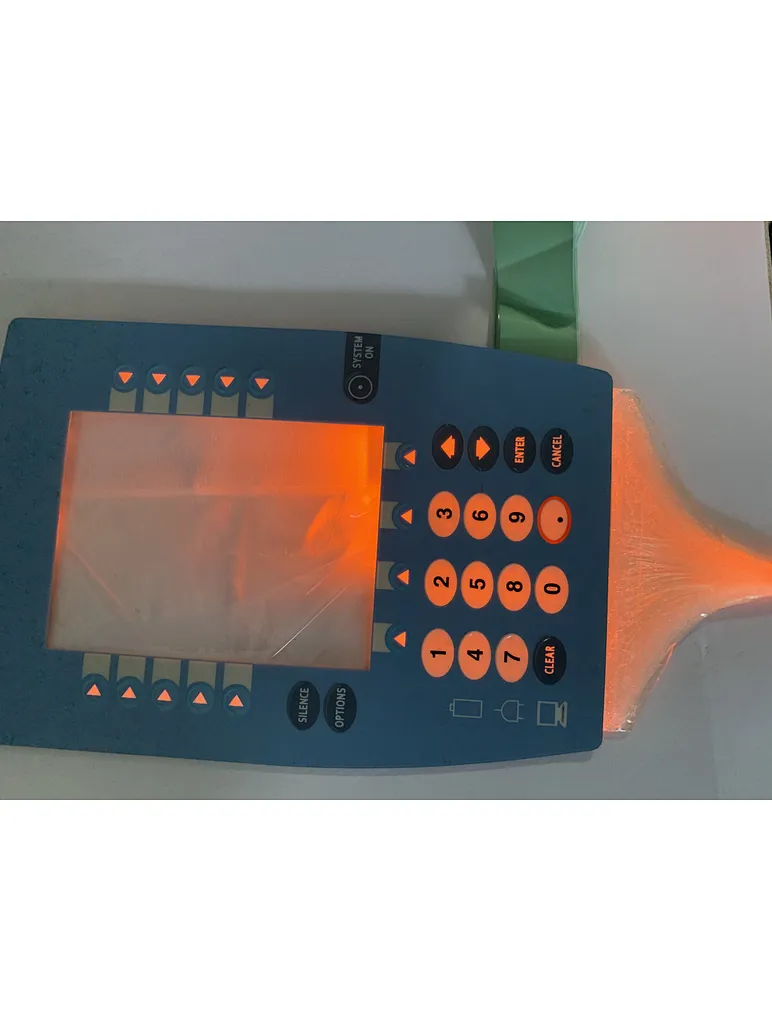
A leading manufacturer of fiber optic medical membrane devices and laboratory equipment contacted Rayera to develop a fiberoptic backlight for a fiber optic medical membrane switch assembly on an IV infusion pump.
The Uniglo fiber optic medical membrane Technology was selected as the backlighting technology, due to its design flexibility, the fiber bending Bendio-Glo process, uniformity, thinness, and durability capabilities. One design challenge on this medical device was to backlight a fiber optic medical membrane switch overlay with a cut-out for an LCD screen in the middle of the panel while utilizing one 5mm LED to backlight the entire assembly. The fiber optic medical membrane panel with one LED was accomplished by selectively extracting the light only in the specific areas that needed to be backlit, thus allowing a decreased quantity of fiber strands to be crimped inside the brass termination of the fiber optic medical membrane panel.